









Corner rounder for precise edge and corner finishing
Our hand-guided trimming systems offer joiners and carpenters the optimal solution for the clean rounding and profiling of corners on edges and panels. Whilst conventional tools often produce inaccurate radii or damage the edge coating, our corner rounders guarantee absolutely uniform transitions on wood and plastic parts thanks to the additional guide. The weight-optimised design saves physical effort during everyday workshop tasks and ensures perfectly rounded edges and corners without the need for manual rework.
Our devices at a glance
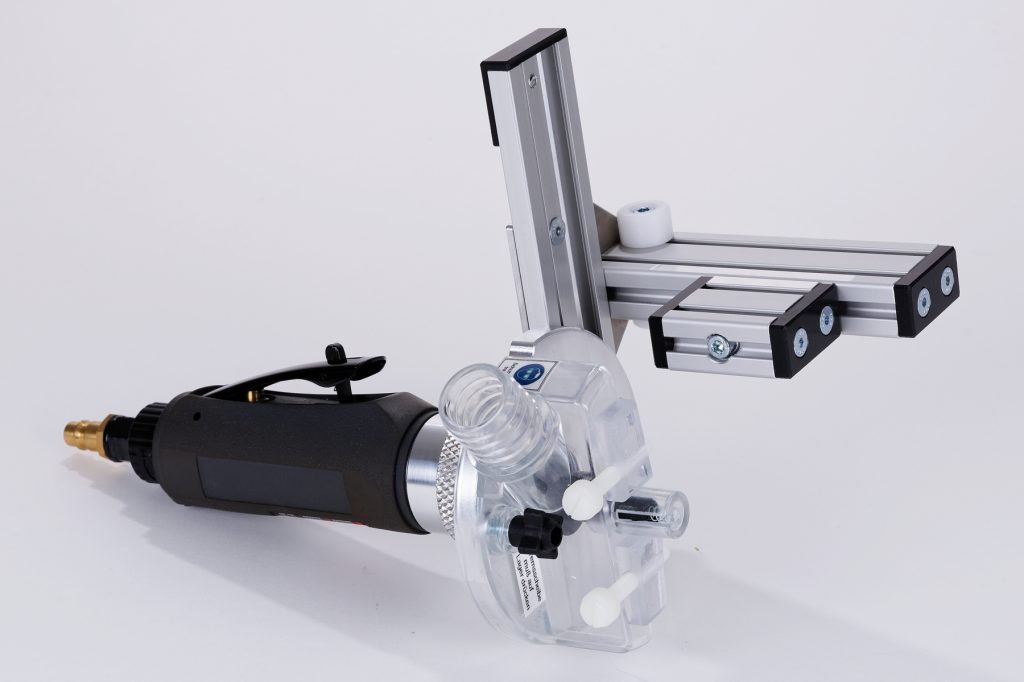
1. The standard professional: Corner rounding machine MZ 02 90F
The tried-and-tested hand tool for precise radii in furniture making and interior fitting.
- What the device does: Accurate and clean rounding of right-angled plate corners (90-degree angles).
- Application area: Ideal for kitchen worktops, counter installations, carcases and fronts made of wood, MDF or coated chipboard.
- Purpose of the tool: Designed for fast, splinter-free corner machining directly on the workpiece, without incurring expensive setup times on the CNC machine.
- Test action: Corner rounders can be tested by commercial businesses for 1 week without obligation and completely free of charge in their own production! Test duration 1 week, test volume approx. 20 corners.
The flexible system: ECKO VZ 100 90F (MFK 1) corner rounding system
The clever modular extension for maximum versatility in the workshop.
- What the device does: System-based rounding and formatting of edge transitions using a perfectly guided router.
- Application area: Ideally suited for businesses with changing requirements looking for a modular and high-precision guide unit for their standard edge router.
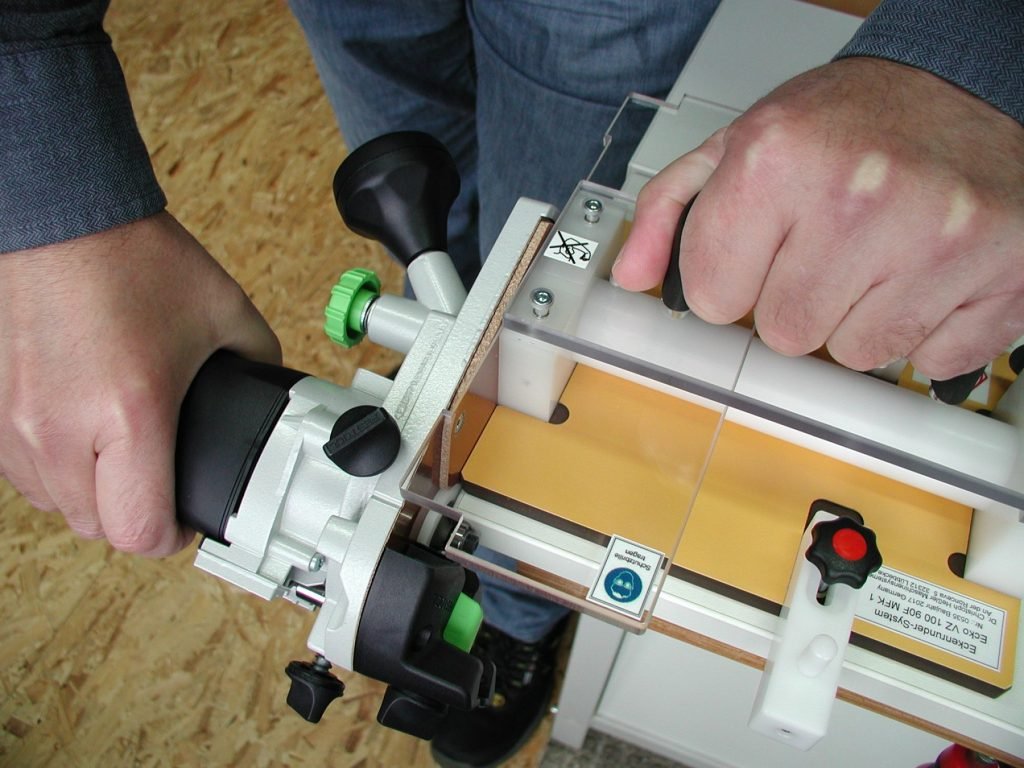
- Purpose of the tool: Designed for repeatable batch and one-off production where the tool must glide over the panel edge with absolute stability and without damaging the surface.
- In-company trial: All systems can be tested by commercial enterprises for one week without obligation and free of charge in their own production!
3. The angle specialist: Corner shaper MZ 01 135V (prototype)
The flexible solution for variable geometries such as obtuse and acute corner areas.
- What the device does: Precise finishing and rounding of edge transitions on angles of up to 135 degrees. Combination of 90-degree corner rounding with rounding on acute and obtuse angles.
- Unique This prototype has a special milling cutter that features a 90-degree R2 profile and a 135-degree profile. In addition, it has a screw-on pin cutter which can be used to pre-cut long edge ends.
- Application area: For shopfitting, exhibition stand construction and special free-forms in high-end interior design, unusual table tops, trapezoidal workpieces, parts for pitched roofs.
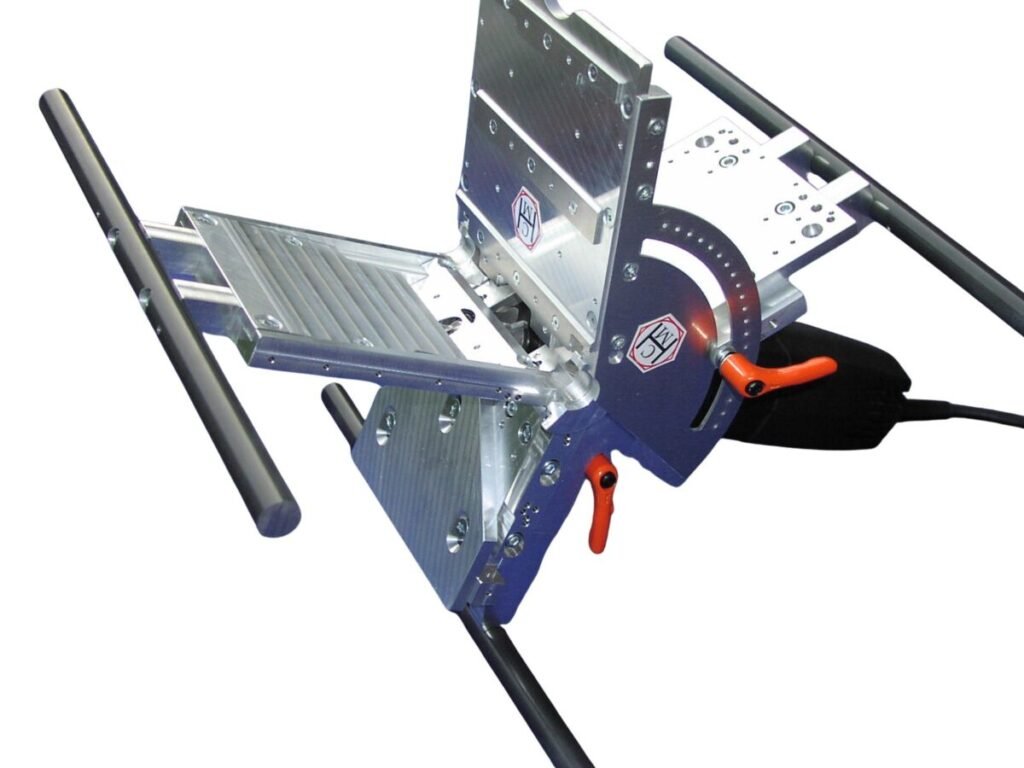
- Purpose of the tool: Designed for components that feature the classic 90-degree standard as well as those that deviate from it. The adjustable guide ensures that the milling tool glides smoothly even on bevels and leaves an absolutely uniform surface finish.
The key practical benefits in focus
For wobble-free guidance:
The thoughtful one slinging and guiding technology prevents jamming and protects sensitive panel coatings from scratches.
For a noticeable saving of time:
Post-processing takes place right on the workbench, which saves time-consuming repositioning or manual reworking.
For low-effort working
The lightweight design ensures a simple Handling and prevents arm fatigue during continuous use.
For maximum investment security
Take advantage of our 1-week, free Practical test directly on your own workpieces
Workflow & Handling
The workflow is optimised for all devices to ensure intuitive and fast handling:
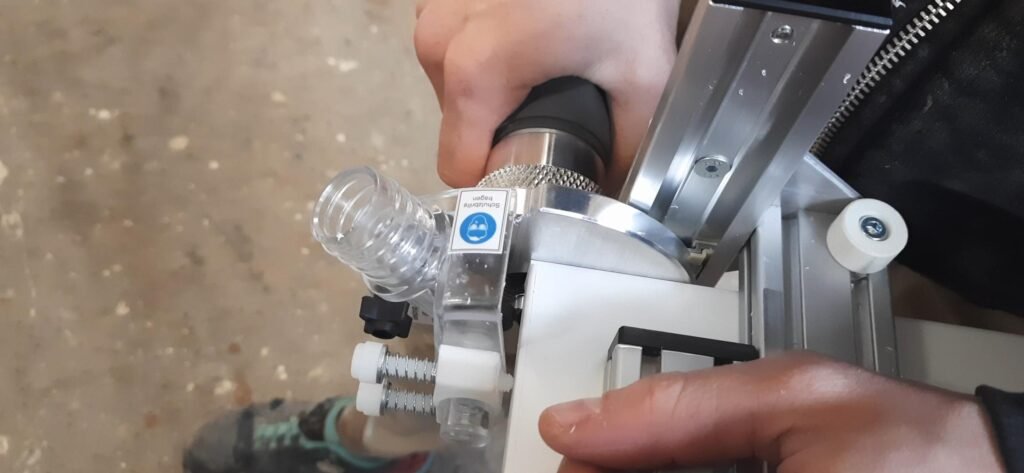
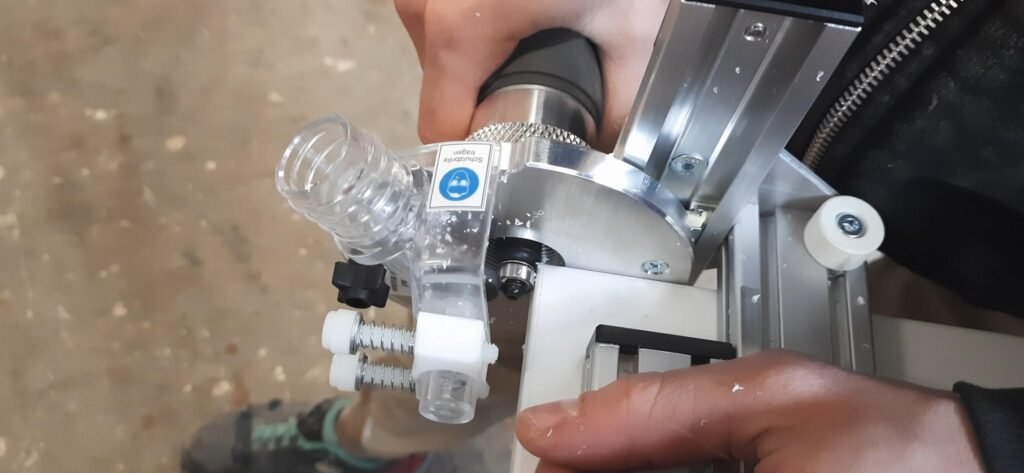
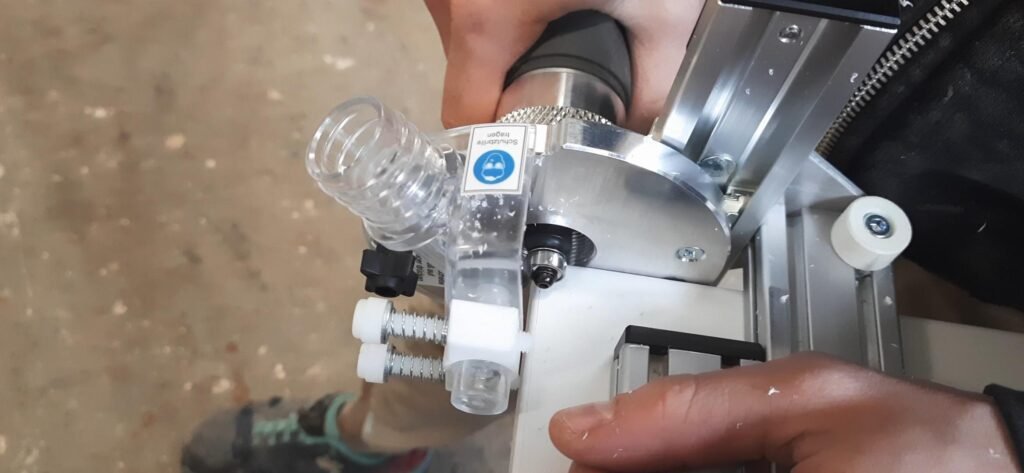
1
Position
The tool with the integrated guide exactly at the workpiece corner create.
2
Edit
Den Milling cutter evenly and guide it around the corner with minimal effort. The tool feedback ensures full control.
3
Finish
An absolute even, clean radius without breakouts, immediately ready for edge-banding or painting.
Precise radii in your workshop: Request your test device now!
Optimise your corner trimming and relieve the pressure on your staff. Even less experienced employees achieve good results. Order your desired Heßler system now available for a one-week free trial!
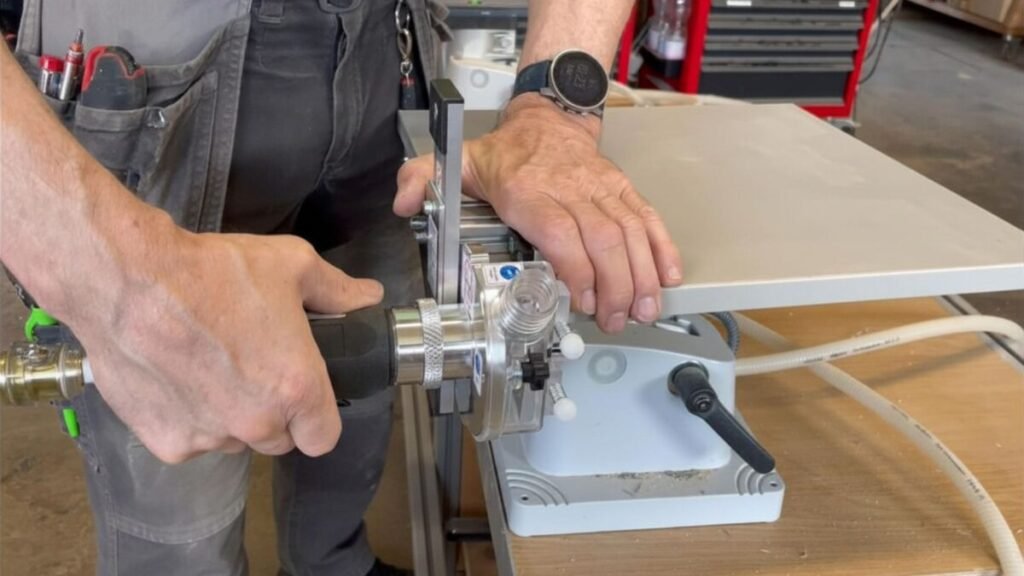
Do you have a special workpiece? Or are you not yet sure how exactly it should work? Simply send us a picture of your workpiece or a drawing. Choose your preferred method:
FAQ about our corner rounders
What are the intended applications of a Heßler corner rounder?
It is used for the fast, precise rounding of corners on edges and panels of wooden and plastic workpieces. The tool is designed to create uniform radii directly on the workbench and to minimise setup times.
Who is a Heßler corner rounder suitable for?
For carpenters and joiners who want to achieve top results when working on corners.
Example 1: Edge banding is done manually. The final operation on the workpiece is intended to finish it safely and quickly, without it being damaged by a file slipping.
Example 2: The edge bander has no corner rounding unit, either because there is a lack of space or because the reliable old machine does not have this function. For a fraction of the price of a stationary machine unit for corner copying, you can achieve professional results.
Example 3: The workpieces are too high, for instance tall posts or worktops. They cannot be processed on conventional edgebanders. With the corner rounders you achieve consistent results without blemishes.
Example 4: The workpieces have a bevelled narrow surface similar to a softforming profile. With multiplex boards, the bevel can be machined cleanly.
Can I also use the devices to work on obtuse or acute angles?
For classic right-angled corners, the MZ 02 90F model is ideal. However, soft-forming profiles with angled narrow sides can also be machined on solid panels with it. Obtuse or acute surface corner angles can be machined with flush cutters, see under flush cutters. If you need to machine bevels or angles up to 135 degrees, the MZ 01 135V corner shaper offers the appropriate adjustable guide.
Which corner rounder is right for me?
The ECKO system is suitable for beginners. For professional, continuous use, we recommend the MZ 02 90F corner rounder. This saves you the setup time required when alternately using the edge router with the ECKO system.
How long have Heßler corner rounders been around?
The corner rounding machine MZ 02 90F was developed in 2008 and presented at the Holz trade fair in Nuremberg in 2010. It has proven its worth in a wide variety of applications. Its first deployment was at an industrial kitchen furniture manufacturer in Austria. Over 10,000 workpieces for a series were processed with it by a joiner in Hesse, Germany. It has also been featured in several trade journals, for example in the magazines BM and dds, as early as February 2009 under the title “Ecken und Kanten im Griff” (Corners and Edges Under Control).
Are the parts of the ECKO system easy to replace if they need servicing?
Yes, the ECKO VZ 100 90F corner rounding system has a modular design. Every component can be replaced individually, meaning that the precise guidance ensures outstanding repeatability with changing workpiece geometries even after many years. The same applies to the MZ 02 90F corner rounding machine.
I have a small workshop that is not big enough to fit an edgebander with corner copying. What can I do?
Here is the MZ 02 90F A corner rounding machine from Heßler, which is the optimal solution. It offers corner rounding or corner copying, meaning that the corresponding unit on the edge bander can be omitted. Especially for joiners and carpenters starting out on their own and still having a small workshop, the corner rounding machine can be a cost-effective and space-saving solution.
Which edge bander is the best and matches the hand-held, mobile corner rounding machine?
The MZ 02 90F corner rounding machine offers corner rounding or corner copying, eliminating the need for the corresponding unit on the edge bander. Here, the MZ 02 90F A corner rounding machine from Heßler is the ideal solution. Especially for joiners and carpenters starting out on their own and still operating a small workshop, the corner rounding machine can be a cost-effective and space-saving solution.
Manufacturer | Machine type | Length | Price (approx.) As of 2026 | Year of manufacture (typical) |
Fields | G 330 | 2.5 m | €7,000–€9,000 | 2010–2020 |
Fields | G 360 | 2.8 m | €9,000–12,000 | 2012–2022 |
Fields | G 380 | 3.0 m | £11,000–£14,000 | 2014–2024 |
Fields | G 500 | 3.2 m | 13.000–17.000 € | 2015–2024 |
Fields | G 560 | 3.4 m | 15.000–19.000 € | 2016–2024 |
Brant | KDN 210 | 3.0 m | 4.500–6.000 € | 1995–2005 |
Brant | KD 56 | 3.1 m | 5.000–7.000 € | 1998–2008 |
Brant | KD 67 | 3.2 m | 6.000–8.000 € | 2000–2010 |
Hebrock | F2 | 2.3 m | 3.500–5.000 € | 1990–2005 |
Hebrock | 2000 | 2.5 m | 3.000–4.500 € | 1985–2000 |
Hebrock | F4 | 2.8 m | 5.000–7.000 € | 1995–2010 |
Hebrock | F5 | 3.0 m | 6.000–8.000 € | 2000–2015 |
Long | B85K | 2.6 m | 8.000–11.000 € | 2005–2020 |
Long | B85 KF | 2.6 m | 10.000–13.000 € | 2008–2022 |
Long | B90 K | 2.8 m | £11,000–£14,000 | 2010–2024 |
Long | B75 K | 2.4 m | €7,000–€9,000 | 2000–2015 |
Long | B100 K | 3.2 m | 12.000–16.000 € | 2012–2024 |
Her Holz | Auriga 1307 | 3.3 m | 40.000–55.000 € | 2015–2024 |
Her Holz | Auriga 1308 | 3.4 m | 45.000–60.000 € | 2016–2024 |
SCM Minimax | ME 20 | 2.6 m | 6.000–8.000 € | 2010–2024 |
SCM Minimax | ME 28 | 2.8 m | €7,000–€9,000 | 2010–2024 |
SCM Minimax | ME 35 | 3.0 m | 8.000–12.000 € | 2012–2024 |
SCM Minimax | ME 40 | 3.2 m | 10.000–14.000 € | 2014–2024 |
SCM Minimax | ME 45 | 3.3 m | 12.000–16.000 € | 2015–2024 |
SCM Minimax | ME 50 | 3.4 m | 14.000–18.000 € | 2016–2024 |
Casadei | E 21 | 2.4 m | 4.000–6.000 € | 1990–2005 |
Casadei | E 25 | 2.6 m | 5.000–7.000 € | 1995–2010 |
Casadei | E 30 | 2.8 m | 6.000–8.000 € | 1998–2012 |
Casadei | E 450 | 3.0 m | 7.000–10.000 € | 2000–2015 |
Casadei | E 550 | 3.2 m | 8.000–12.000 € | 2005–2020 |
OTT | Pacific 1000 | 3.0 m | 6.000–9.000 € | 1985–2000 |
OTT | Pacific 1300 | 3.3 m | 7.000–11.000 € | 1990–2005 |
OTT | Tornado 1300 | 3.4 m | 8.000–12.000 € | 1995–2010 |
OTT | Tornado 1600 | 3.8 m | 10.000–14.000 € | 2000–2015 |
OTT | Storm 1200 | 3.2 m | 7.000–10.000 € | 1995–2010 |
OTT | Storm 1600 | 3.8 m | 9.000–13.000 € | 2000–2015 |
Biesse | Akron 1300 | 3.0 m | 8.000–12.000 € | 2005–2015 |
Biesse | Akron 1400 | 3.2 m | 9.000–13.000 € | 2008–2018 |
Biesse | Akron 210 | 2.8 m | 6.000–9.000 € | 1998–2008 |
Biesse | Akron 310 | 3.0 m | 7.000–10.000 € | 2000–2010 |
Biesse | Jade 240 | 2.6 m | 5.000–7.000 € | 1995–2005 |
Biesse | Jade 340 | 2.8 m | 6.000–8.000 € | 1998–2008 |
How much can I save with a Heßler corner rounder on a contour gluing machine?
For each machine in the table above, the technically highest model was selected. with Corner rounds/corner copying are determined, thereby determining a realistic price difference.
- Small machines: +4,000 to +7,000 €
- Middle class: +7,000 to +10,000 €
- Wood-Her / large chisel / large SCM: +20,000 to +35,000 €
The price difference is so large even in the most economical machine class that the corner rounder with a price of €620 net (as of July 2026) pays off very quickly.
Manufacturer | Model without Corner rounds | Length without | Price without € | Comparison model with Corner rounds | Length with | Price with € | Price € k=1000 | Information for buyers |
Fields | G 330 | 2.5 m | 7–9k | G 360 R | 2.8 m | 12–15k | +5–6k | Easily retrofitted with the corner round MZ 02 90F at a low price |
Fields | G 360 | 2.8 m | 9–12k | G 380 R | 3.0 m | 14–18k | +5–6k | Refitting corners instead of buying an expensive machine |
Fields | G 380 | 3.0 m | 11–14k | G 480 R | 3.4 m | 18–24k | +7–10k | MZ 02 90F saves up to €10,000 compared to buying new |
Fields | G 500 | 3.2 m | 13–17k | G 560 R | 3.4 m | 22–28k | +9–11k | Professional upgrade with MZ 02 90F without machine replacement |
Fields | G 560 | 3.4 m | 15–19k | G 580 R | 3.6 m | 25–32k | +10–13k | Retrofitting instead of investing €30,000 |
Brant | KDN 210 | 3.0 m | 4.5–6k | KD 56 R | 3.1 m | 8–12k | +4–6k | Ideal for older Brandt machines – MZ 02 90F fits perfectly |
Brant | KD 56 | 3.1 m | 5–7k | KD 67 R | 3.2 m | 10–14k | +5–7k | Retrofit corner rounds instead of replacing machines |
Brant | KD 67 | 3.2 m | 6–8k | KD 78 R | 3.4 m | 12–16k | +6–8k | Perfect for cabinetmakers with a budget-conscious approach |
Hebrock | F2 | 2.3 m | 3.5–5k | F4 R | 2.8 m | 7–10k | +3.5–5k | MZ 02 90F makes small machines big |
Hebrock | 2000 | 2.5 m | 3–4.5k | F2 R | 2.3 m | 7–10k | +4–6k | Retrofitting instead of replacing machines |
Hebrock | F4 | 2.8 m | 5–7k | F5 R | 3.0 m | 10–13k | +5–6k | Corner round MZ 02 90F = F5 performance |
Hebrock | F5 | 3.0 m | 6–8k | F7 / AKV 3005 | 3.2 m | 12–16k | +6–8k | Upgrading saves up to €8,000 |
Long | B85K | 2.6 m | 8–11k | B85 KR | 2.8 m | 14–18k | +6–7k | MZ 02 90F = KR performance without KR price |
Long | B85 KF | 2.6 m | 10–13k | B85 KFR | 2.8 m | 16–20k | +6–7k | Retrofitting instead of investing €20,000 |
Long | B90 K | 2.8 m | 11–14k | B90 KR | 3.0 m | 18–23k | +7–9k | The corner roundings make the B90 KR unnecessary |
Long | B75 K | 2.4 m | 7–9k | B75 KR | 2.6 m | 12–16k | +5–7k | Budget solution: Keep the machine, supplement it with the MZ 02 90F |
Long | B100 K | 3.2 m | 12–16k | B100 KR | 3.4 m | 20–26k | +8–10k | Corner roundings save up to €10,000 |
Her Holz | Auriga 1307 | 3.3 m | 40–55k | Auriga 1308 XL | 3.4 m | 65–85k | +25–30k | MZ 02 90F = Professional upgrade without the XL price |
Her Holz | Auriga 1308 | 3.4 m | 45–60k | Sprint 1329 | 3.6 m | 70–95k | +25–35k | Retrofitting instead of a sprint price |
SCM Minimax | ME 20 | 2.6 m | 6–8k | ME 28T | 2.8 m | 12–15k | +6–7k | MZ 02 90F transforms the ME20 into the ME28T class |
SCM Minimax | ME 28 | 2.8 m | 7–9k | ME 35T | 3.0 m | 13–17k | +6–8k | Upgrading instead of buying new |
SCM Minimax | ME 35 | 3.0 m | 8–12k | ME 40T | 3.2 m | 15–20k | +7–8k | Corner round = ME40T performance |
SCM Minimax | ME 40 | 3.2 m | 10–14k | ME 50T | 3.4 m | 18–24k | +8–10k | Corner roundings save up to €10,000 |
SCM Minimax | ME 45 | 3.3 m | 12–16k | ME 50T | 3.4 m | 18–24k | +6–8k | Round corners instead of machine changes |
SCM Minimax | ME 50 | 3.4 m | 14–18k | ME 50T | 3.4 m | 18–24k | +4–6k | MZ 02 90F = T-version without extra charge |
Casadei | E 21 | 2.4 m | 4–6k | E 25 R | 2.6 m | 8–11k | +4–5k | Perfect for small workshops |
Casadei | E 25 | 2.6 m | 5–7k | E 30 R | 2.8 m | 9–13k | +4–6k | Eckenrunder makes the E25 competitive |
Casadei | E 30 | 2.8 m | 6–8k | E 450 R | 3.0 m | 12–16k | +6–8k | Upgrade instead of buying the E450 |
Casadei | E 450 | 3.0 m | 7–10k | E 550 R | 3.2 m | 14–18k | +7–8k | Corner roundings save up to €8,000 |
Casadei | E 550 | 3.2 m | 8–12k | E 600 R | 3.4 m | 16–22k | +8–10k | Retrofitting instead of the E600 |
OTT | Pacific 1000 | 3.0 m | 6–9k | Pacific 1300 R | 3.3 m | 12–16k | +6–7k | MZ 02 90F makes old OTT modern again |
OTT | Pacific 1300 | 3.3 m | 7–11k | Tornado 1300 R | 3.4 m | 14–18k | +7–7k | Upgrade instead of buying a Tornado |
OTT | Tornado 1300 | 3.4 m | 8–12k | Tornado 1600 R | 3.8 m | 16–22k | +8–10k | Corner roundings save up to €10,000 |
OTT | Tornado 1600 | 3.8 m | 10–14k | Storm 1600 R | 3.8 m | 18–24k | +8–10k | Retrofitting instead of buying a Storm |
OTT | Storm 1200 | 3.2 m | 7–10k | Storm 1600 R | 3.8 m | 18–24k | +11–14k | Great performance for a small price with the MZ 02 90F |
Biesse | Akron 1300 | 3.0 m | 8–12k | Akron 1330 A | 3.2 m | 16–22k | +8–10k | MZ 02 90F converts the 1300 into the 1330 class |
Biesse | Akron 1400 | 3.2 m | 9–13k | Akron 1440 R | 3.4 m | 18–24k | +9–11k | Upgrading instead of buying new |
Biesse | Akron 210 | 2.8 m | 6–9k | Akron 310 R | 3.0 m | 12–16k | +6–7k | Corner round = 310 power |
Biesse | Akron 310 | 3.0 m | 7–10k | Akron 440 R | 3.4 m | 14–20k | +7–10k | Retrofitting saves up to €10,000 |
Biesse | Jade 240 | 2.6 m | 5–7k | Jade 340 R | 2.8 m | 10–14k | +5–7k | Eckenrunder makes the Jade competitive |
Biesse | Jade 340 | 2.8 m | 6–8k | Jade 440 R | 3.0 m | 12–16k | +6–8k | Upgrade instead of buying the Jade 440 |
What does corner rounding mean in a edge gluing machine?
Edge rounding is the process of carefully rounding the sharp, front and rear edges of a workpiece after edge bonding. Without edge rounding, the edges remain visible and vulnerable to damage, and the workpiece is only partially usable.
Why do many edge gluing machines not have an edge rounding unit?
For a long time, corner rounding was only available in expensive machine classes. Many carpentry shops therefore opt for cheaper models without corner rounding – with the disadvantage of a lower edge quality.
Can I retrofit corner rounds?
Yes. The corner round MZ 02 90F has been specially designed to retrofit corner roundings as a separate work step – regardless of manufacturer, model year or machine type.
Which machines can be retrofitted with the MZ 02 90F?
The MZ 02 90F is compatible with all common edge gluing machines, including Felder, SCM/Minimax, Biesse, Hebrock, Brandt/Homag, Lange, OTT, Casadei and Holz‑Her.
Why should I retrofit corners instead of buying a new machine?
Machines with rounded corners cost between €5,000 and €35,000 more depending on the manufacturer than models without rounded corners. The rounded corner MZ 02 90F offers the same function for a fraction of the cost.
How does the MZ 02 90F improve my edge quality?
The MZ 02 90F produces clean curves, perfect transitions and a high-quality finish like premium edge gluing machines. Repainting and sanding work are significantly reduced.
How quickly can I use the corner rounding?
The MZ 02 90F is immediately ready for use. It requires no machine modifications, no electrical wiring, and no complicated settings. Simply set it up and get started.
Is the MZ 02 90F suitable for mass production?
Yes. The corner grinder is designed for permanent, professional use and is used daily in many workshops.
How much time do I save with the corner rounding?
Depending on the workpiece size, up to 70 % and more hours of rework can be saved. Manual rounding is completely eliminated.
Why Heßler?
The MZ 02 90F is developed and manufactured in Germany; it is extremely robust, low-maintenance, and compatible with all common edge materials. It has been proven in the trades and industry for years.