










Professional notchers for woodworking and plastic processing
Our hand-guided notchers offer carpenters, joiners, and the timber construction industry a highly efficient solution for rapidly, precisely, and absolutely sharply finishing milling radii and rounding corners in internal corners. Whether it's a delicate kitchen countertop or solid cross-laminated timber (CLT), our new developments elevate the laborious and error-prone manual work with chisels, files, saws, or chain mortisers to a new level of precision. By processing outside the CNC machine, you save valuable setup times, avoid expensive repositioning, and massively increase the value of your workpieces. Thanks to durable diamond cutters and sophisticated ergonomics, you'll achieve perfect results in no time with maximum cost and time savings.
Our devices at a glance
1. The classic: Notcher MZ 02 90F A
The precision tool for furniture and interior fitting (MDF, wood, plastic).
- What the device can do: Mills radii and curves into inside corners with sharp edges to a hundredth of a millimetre; equipped with a tracer milling unit to transfer the precision to the workpiece. Standard stroke: 60 mm.
- Where it is used Ideal for machining board materials, kitchen worktops, counters, and cut-outs in furniture making, shopfitting, exhibition stand construction and shipbuilding.
- What the advantages are Massive time savings compared to manual work, zero risk of waste with coated panels, extremely simple operation and a 1-week free, no-obligation trial. Trial period 1 week, trial scope about 20 corners.
- Price: £2,910.00 (net)
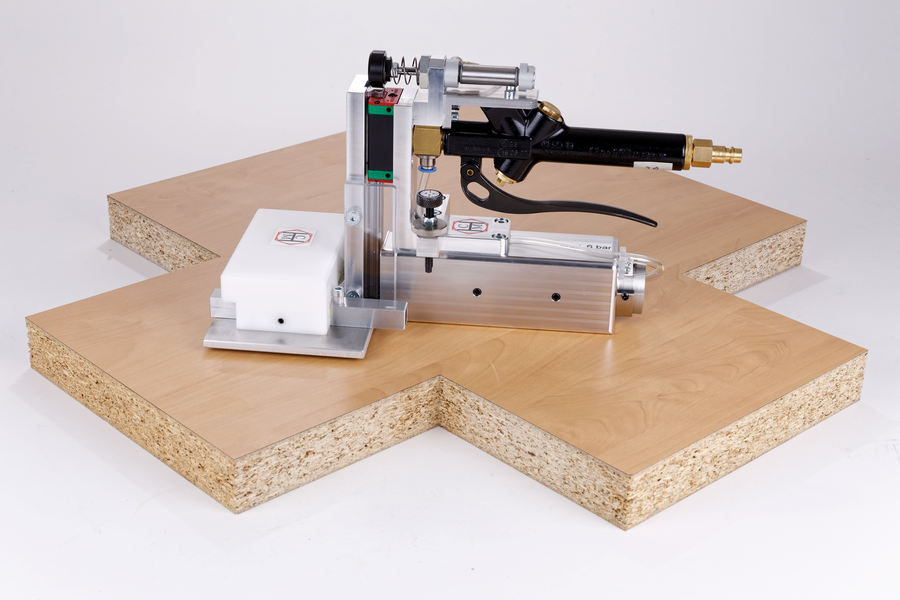
- Test action: Commercial businesses can test corner notchers non-binding and completely free of charge in their own production for 1 week! Test duration 1 week, test scope about 20 corners.
2. The powerhouse: Large notcher MZ 02 90F A E
The robust machine for structural timber construction (solid timber & CLT).
- What the device can do: Provides maximum routing performance for thick, solid timber cross-sections; sturdy construction made of solid aluminium plates (weight: 13.5 kg).
- What it's for: Milling out the rounding in the inside corners that remain after contour milling. Instead of a chain mortiser, without introducing oil into the workpiece. Instead of a chisel, precise and fast.
- Price: £5,375.00 (net)
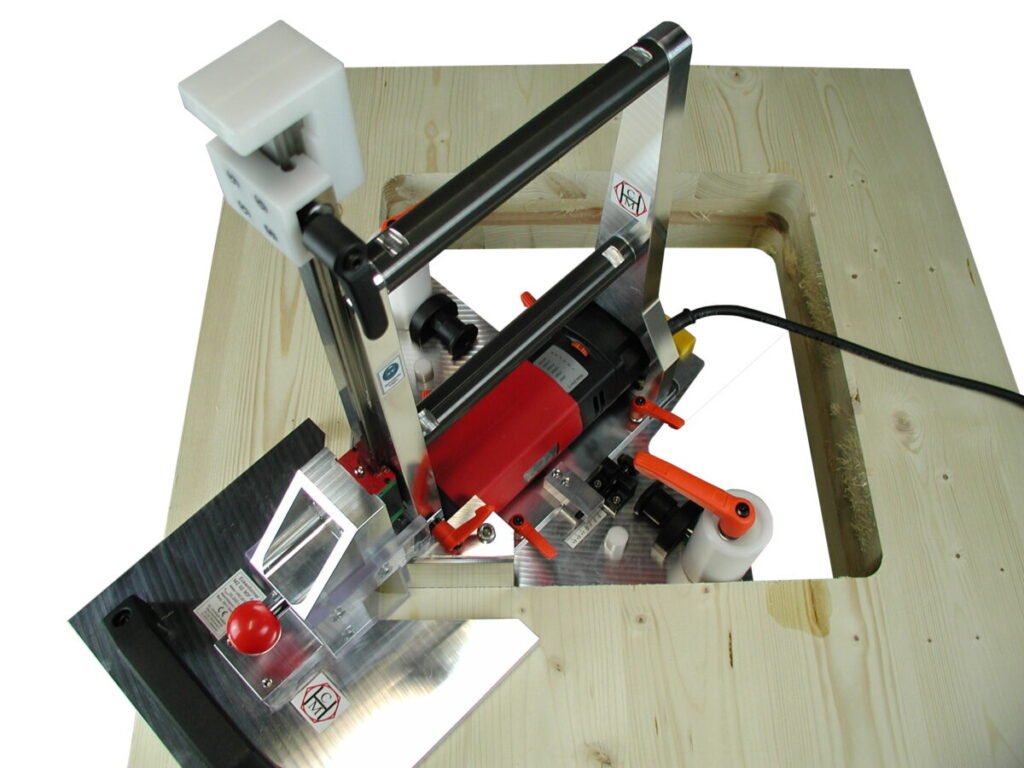
- Where it is used Specially designed for the machining of cross-laminated timber (CLT), solid structural timber and large wooden components (e.g. at the Stora Enso plant)
- What the advantages are No time-consuming, mill-accurate repositioning of multi-tonne components on the CNC machine – the corners are machined outside the machine while the CNC is already milling the next part.
3. The ergonomic power tool: MZ 02 90F A L lightweight notcher
The weight-optimised innovation for deep, flexible working in cross-laminated timber.
- What the device can do: Full power for CLT at a radically reduced weight of just under 4 kg (instead of 13.5 kg); allows corner rounding to be routed right down to a base or rebate, as well as deep working up to 290 mm and more.
- Unique The corner radius can be neatly milled right down to a floor in the workpiece. The floor no longer needs to be reworked with a chisel.
- Where it is used For cut-outs in cross-laminated timber / CLT (plunging from approx. 200×200 mm to 250×250 mm, piercing through from 400×400 mm).
- Price: €2,910.00 (net)
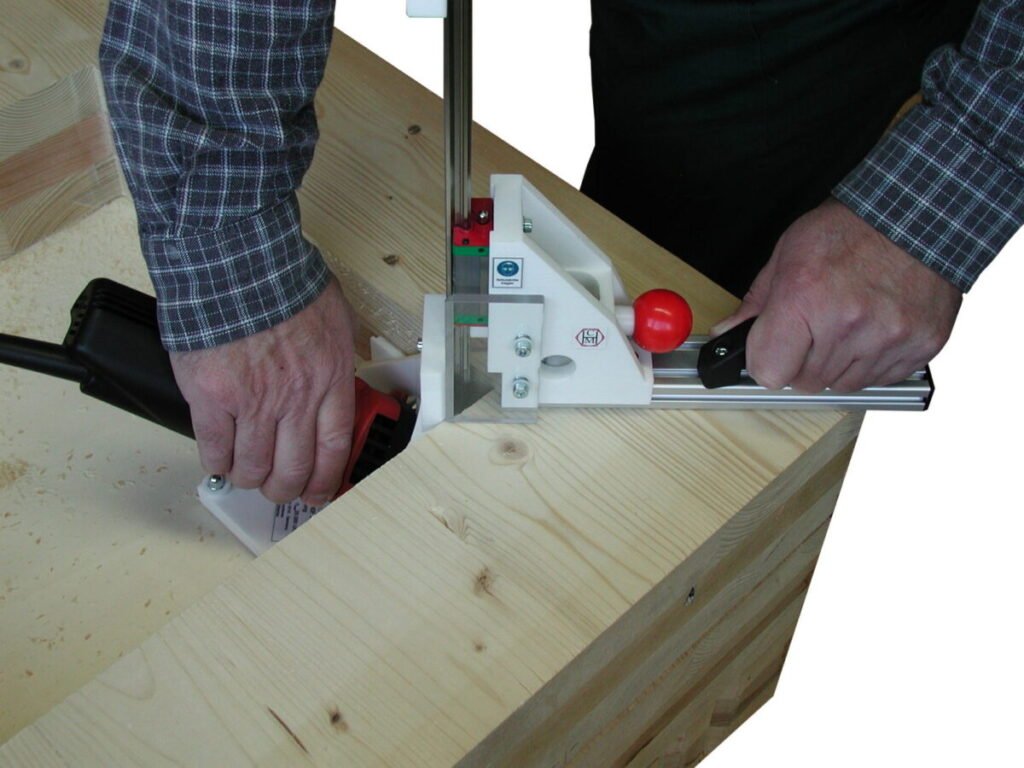
- What the advantages are Maximally ergonomic, fatigue-free working due to massive weight savings; delivers site-ready, higher-quality workpieces straight from the factory.
- Test action: Commercial businesses can test corner notchers non-binding and completely free of charge in their own production for 1 week! Test duration 1 week, test scope about 20 corners.
All benefits at a glance
Production efficiency boost
Milling Inside corners simply outside the CNC machine ready, while the system is already processing the next workpiece.
No expensive repositioning
Especially with large Solid wood or CLT panels the extremely complex and time-consuming alignment after the main milling operation is eliminated.
Value added for your customers
You deliver perfectly finished, higher-grade workpieces – an on-site trend that is becoming increasingly important in modern timber construction.
Material protection
Whether it is a delicate coating on a furniture recess or deep routing down to the rebate on a light recess, the workpiece is optimally protected.
How the disengaging mechanism technology works
The workflow is optimised for all devices to ensure intuitive and fast handling:


1
Create
The stop housing of the notcher is in the Internal corner created, where the radius is still present after CNC milling.
2
Activate
Pull the starter lever or press the switch – the motor starts and the pneumatic cylinders withdraws or the operator pulls one locking bolt controlled retreat.
3
feed
The rotating milling cutter is continuously advanced through the wood or plastic material and removes the rounding in no time at all.
4
Double-sided milling (furniture sector)
With thicker plates, the depth stop First the first side milled, the workpiece turned over and perfectly done from the back cleanly finish-milled.
5
Graduation
Just put the motor back into the Starting position push back.Before Release the starter lever (compressed air) or then slide the switch back (electric).
6
Result
The fillet in the internal corner is cleanly milled. An internal corner has been finished to a sharp point. The machine is ready for the next internal corner.
Test our notchers
Make use of our 1-week, no-obligation and free trial period directly at your premises (applies to the MZ 02 90F A model). Test duration 1 week, test scope 20 corners.

Do you have a specific notching task or question? Simply send us a picture of your workpiece or a drawing. Choose your preferred method:
FAQ about notched bars
Question: Why should I process the corners in CLT manufacturing outside of the CNC machine using a notched cut?
Answer: When cutting out openings (e.g. in cross-laminated timber), the inner part often remains stuck in the workpiece. To remove it, the part has to be taken off the CNC – subsequently repositioning it on the machine with milling accuracy is extremely time-consuming. With the notcher, you can simply and flexibly process the corners next to the machine while the CNC system is already producing the next workpiece.
Question: What is the main difference between the heavy-duty notcher and the light notcher?
Answer: Both are designed for solid wood and CLT. The heavy-duty notched-recess cutter (13.5 kg) is built extremely robustly from aluminium plates and designed for the toughest continuous industrial loads. Thanks to its modern design, the lightweight notched-recess cutter weighs just under 4 kg, conserves workers' energy during daily use, has also proven itself in continuous industrial use, and additionally allows routing in deep cut-outs (up to 290 mm and more) as well as directly down to a rebate or floor.
Question: Which radii and plate thicknesses can the standard notcher (furniture) process?
Answer: The standard notcher MZ 02 90F A can remove curves and radii up to 12.5 mm. If the underside is to be tear-free, the following applies depending on the workpiece thickness: at a thickness of 16 mm, an inner radius of max. 8 mm is removed, at 18 mm thickness max. 10 mm, and from 19 mm thickness a maximum inner radius of 12.5 mm.
The CLT notchers can remove radii up to 20 mm.
Question: Are the machines delivered ready for use?
Answer: Yes. Every device is pre-tested on real wood/plastic at our factory, approved, and delivered completely ready for operation, including a mounted and precisely pre-set diamond cutter, operating instructions, tools and an initial supply of compressed air tool oil.
Question: I have never seen the notcher before. How long has the notcher been around?
Answer: The standard notcher has been in use since 2010 and was presented at the timber trade fair in Nuremberg. It was previously developed and used in practical application at a kitchen worktop supplier in Germany. It has proven its worth to the full and is used today by carpenters and joiners in both industry and the trades, both domestically and abroad, e.g., at Häcker, Nobilia, Safenwil, Scheschy, and Neuform-Türenwerke.
When notching, are knives or chisels pressed into the workpiece?
Answer: No. Although the notcher (Ausklinker) gets its name from the familiar concept of notching (Ausklinken), it does not work with pawls (Klinken). In fact, it uses a special milling cutter that machines away the radius in the inside corner on both sides of the inside corner simultaneously. Therefore, it works quickly, precisely, and very gently on the workpiece.
Question: Is there a business near me where we can look at the coping brick?
Answer: Please get in touch with us. We will then find the nearest branch for you. Alternatively, you can contact us regarding a trial if you are a commercial user.
Question: What other terms are used for notching?
Answer: Just as there are regional differences for the job title – Tischler and Schreiner – there are also many other terms for notching. Examples include: sharpening corners, squaring corners with sharp edges, chiselling out corners, routing out corners, and correspondingly corner sharpener, corner router, corner cutter, corner chiseller, corner punch. Is another term commonly used in your area? Then get in touch with us. For every new term, we will send you a high-quality metal ballpoint pen as a thank you.
Question: Is the notch cutter (furniture) also available cordless or electric?
Answer: No. Electric motors are larger than the pneumatic motor used. Furthermore, the pneumatic motor used is a special motor with a small diameter. This allows the motor to be positioned directly behind the cutter. From a plate thickness of 16 mm, routing can be carried out from the first side without breakout already occurring on the second side. This would not be possible with an electric motor, or only through a complex design involving greater weight and higher costs.
Question: We could probably use the notch cutter for our application if the design were slightly modified. Do you also do customisations for individual customers?
Answer: Yes. We are very interested in getting to know your requirements. We have already carried out many bespoke customisations.
Example 1: As standard, we require cut-outs with a side length of at least 200 mm. We have also made cuts measuring approximately 60 mm x 80 mm possible with an additional stop. The application concerned the partition walls in the changing area of a swimming pool.
Example 2: A door manufacturer wanted to design the glass cutout with side surfaces inclined at 15°. To achieve this, we built a notched cutter with a double-offset linear axis and designed, manufactured and installed additional stops. In addition, the cutter was modified with a conical outer contour. Similar to a bevel cut, the curves can now be cleanly removed after milling in an internal corner with inclined side surfaces.
Example 3: A kitchen manufacturer asked us whether we could flush-mill an inside corner only up to a rebate instead of all the way through. We were able to offer a solution by modifying the Ausklinker Leicht (CLT) for furniture making and kitchen worktops with a different linear guide and specially milled stops made of Pertinax.
Example 4: For pine/spruce parts where splinter-free cutting was not critical, we had the following case with a furniture manufacturer:
The panels were 3-layer solid spruce panels, 38 mm thick. The cut-outs were 42 mm wide and 11 mm deep. They were 3-sided cut-outs, which is why we often refer to them as notches. The radius in the internal corners prior to machining was 5 mm. The solution involved modifying the stop area of the notcher and adding new stops. This allowed the first internal corner to be cleared in the downward stroke and the second internal corner to be cleared immediately afterwards in the upward stroke.
Example 5: A major manufacturer of ready-to-install CLT (cross-laminated timber) prefabricated walls wanted to use the Ausklinker Leicht for thicker walls. We were able to implement this with minimal effort by using a longer linear guide.
Question: Why are the notches so precise?
Answer: The notches are placed directly against the workpiece in the internal corner. This results in what is known as tracer milling. The rotating cutter is guided through the internal corner while maintaining constant contact between the stops and the workpiece. If this is done on a CNC machining centre using a cutter, the position is approached according to the coordinates in the controller. However, machining centres for wood panel processing generally do not offer accuracies better than 0.1 mm at best. Practical reports after several years of use also frequently mention 0.3 mm. In addition, the machine spindle must be exactly plumb and must not have been distorted by bottoming out. As a result, when machining the radius, the entire radius is sometimes never completely removed, and a residue is always left standing in the corner. This residue is then subsequently removed by hand using a file.
Here, the furniture notcher offers a precise, fast and reliable alternative with a high degree of accuracy better than 0.1 mm. The router bit is set to 0.01 to 0.03 mm relative to the stops. The risk of scrap is reduced to a minimum.
Question: How large can the cut-outs or recesses be so that I can machine them with the furniture notcher MZ 02 90F A?
Answer: The limit values depend on the dimensions of the cut-out and whether the workpiece needs to be free of tear-out.
A cutout has 4 workpiece sides and lies in a plate.
A cutout has a maximum of 3 workpiece sides and is located on the edge of a panel.
- The workpice must be free of tear-out by milling from both sides.
1.1 ExcerptsThen the smallest side must be 200 mm or more in length.
1.2 CutsOnly the middle page needs to be from 200 mm long.
- The workpiece does not need to be splinter-free, or any splintering can be prevented by placing a backing piece underneath.
2.1 ExcerptsFrom rectangle 60 mm x 200 mm.
2.2 CutsFrom 60 mm x 80 mm.
It also depends on the sheet thickness and the internal corner radius. Get in touch with us
What does your work piece look like? Tel. +49 (0)5741 3012080