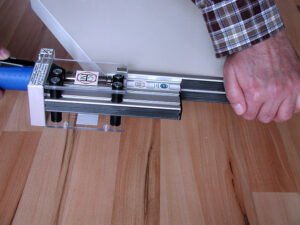


Flush milling cutter for glued edges on wooden furniture parts: All-angle flush milling cutter MZ 100 160V
Technical features
- Very lightweight engine with excellent handling
- Finishing chamfering of edge residues up to 160°
- Faster angle change without adjustment
- Clean, precise milling result
- Pneumatic drive with carbide-tipped end mills
830,00 € without VAT.
Problem:
Adhered edges on wooden furniture parts are often visible over — especially on non-circular workpieces such as trapezoidal shapes, sloping roofs, or chamfered fronts. Conventional hand-operated machines often cannot process these angles cleanly. This leads to Ripped, uneven results and time loss.
Solution:
The All-angle end mills MZ 100 160V carves protruding edge strips precise, clean and without adjustment settings. It is specially designed for carpenters and joiners who attached edges on wooden furniture parts Need to be able to quickly and reproducibly mill straight edges — even at angles up to 160°.


How it works
- The compressed-air motor drives the carbide-tipped end mill
- The mounting rail is placed on the side of the workpiece
- Bending-resistant aluminum construction ensures precise guidance
- The buffer layer rolls off the edge of the neighboring surface and protects the surface
- No adjustment of movable stops — angle change takes place directly
Technical highlights
- Perfect for attached edges on wooden furniture parts
- Finishing grinding up to α = 160°
- Tool attached directly to the spindle
- Setup storage for defined milling distances
- No damage to the adjacent edge
- Very lightweight, ergonomic, hand-held
- Faster switching between different angles
- High-quality German air compressor motor
- Protection rights at the German Patent and Trademark Office
Use cases
- Finishing chamfering of glued wood or plastic edges
- Processing of roof ridge parts
- Trapeze tables and chamfered fronts
- Countertop manufacturing (top and bottom)
- Corner machining of non-angular furniture parts

Before:
Excess edge strips at corners and at angles up to 160° must be painstakingly manually processed — often with inconsistent results and visible marks.
Later:
The edges are cleanly and precisely milled without any gaps, without any reworking, and with a perfect surface — regardless of the angle.
Scope of delivery
- Machine All-Angle Bevel Grinder MZ 100 160V
- Sliver mounted and preset
- Test run on wood/plastic
- Standard equipment compressed air equipment oil
- Operating instructions
- Tool
Technical data
| Characteristic | Value |
|---|---|
| Drive system | Pneumatic pressure air motor |
| Tool | Hard metal end mills with lead-in bearing |
| Angle range | up to α = 160° |
| Design | Bending-resistant aluminum unit |
| Surface | Protection through a buffer storage facility |
| Materials | Wood, plastic |
| Weight | very light (pneumatically) |
| SKU | buendig-fraeser-for-glued-edges-on-wood-furniture-parts |
Would you like to test our product or purchase it?
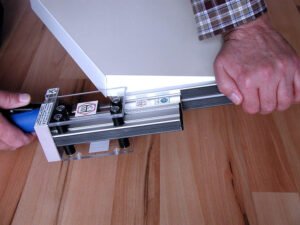
Preparation: Roughly cut off the excess edge to about 3mm, max. about 6mm, and put on protective goggles.
Right corner:
1. With the right hand, circle the motor with the right corner.
2. Wrap the impact rail with your left hand.
3. Press the workpiece with the left hand.
4. The left hand forms a pivot bearing.
5. The tool is rotated from the bottom up, removing the excess material along the way.
Left corner:
Rotate machine around longitudinal axis, drain corresponding to right-hand corner